New here and low on energy? Press play and just listen, eyes closed if you like. Or read the basics below.
Two AI hosts talk through the research in everyday words. Want to ask your own questions? Open it in NotebookLM.
Start Here: The Basics
Your blood vessels are lined with a thin, living layer of cells. When that lining stops working smoothly, blood flow and oxygen delivery get thrown off all over your body. That's endothelial dysfunction.
A picture to hold onto
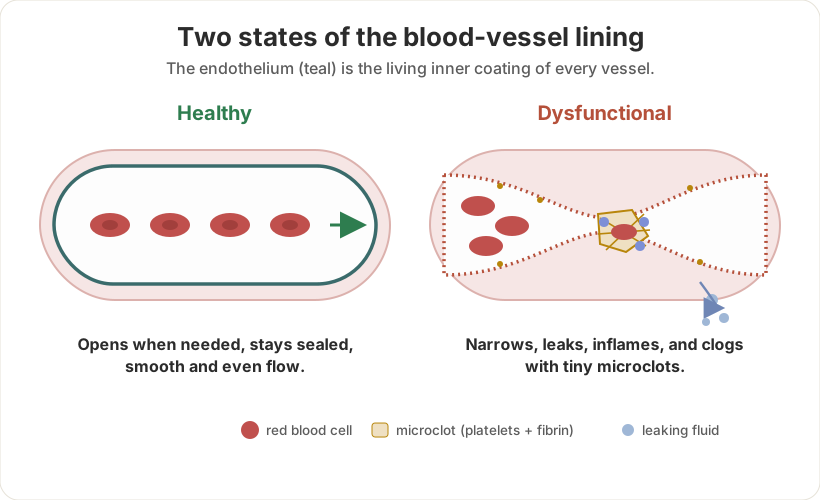
Think of every blood vessel as a garden hose. The inside of that hose is coated with a smart, living surface that can widen the hose when a part of you needs more blood, tighten it when you don't, keep the flow smooth, and stop leaks. That smart coating is the endothelium.
It's not just plumbing. It's an active, decision-making organ spread across your whole body, lining every artery, vein, and tiny capillary you have. When it's healthy, you never think about it. When it's dysfunctional, the hose constricts when it should relax, leaks when it should stay sealed, and signals alarm when there's no fire. The blood still flows, but the smart control is off.
Why this happens after a virus
COVID and other viruses can injure the endothelium directly and set off a wave of inflammation while you're acutely sick. In most people, things settle back to normal. In some people, they don't, and the vascular system stays stuck in a low-grade alarm state. Researchers point to a few overlapping reasons:
- Direct injury to the vessel lining from the virus
- Persistent inflammation and an immune system that stays switched on
- Abnormal clotting, including tiny microclots that clog the smallest vessels
- Reduced nitric oxide, the signal vessels use to relax and widen
You don't need to memorize these. The takeaway is simpler: this is a real, physical, vascular problem. Not a matter of being out of shape or imagining things.
↑ back to topWhy It Makes So Many Things Go Wrong
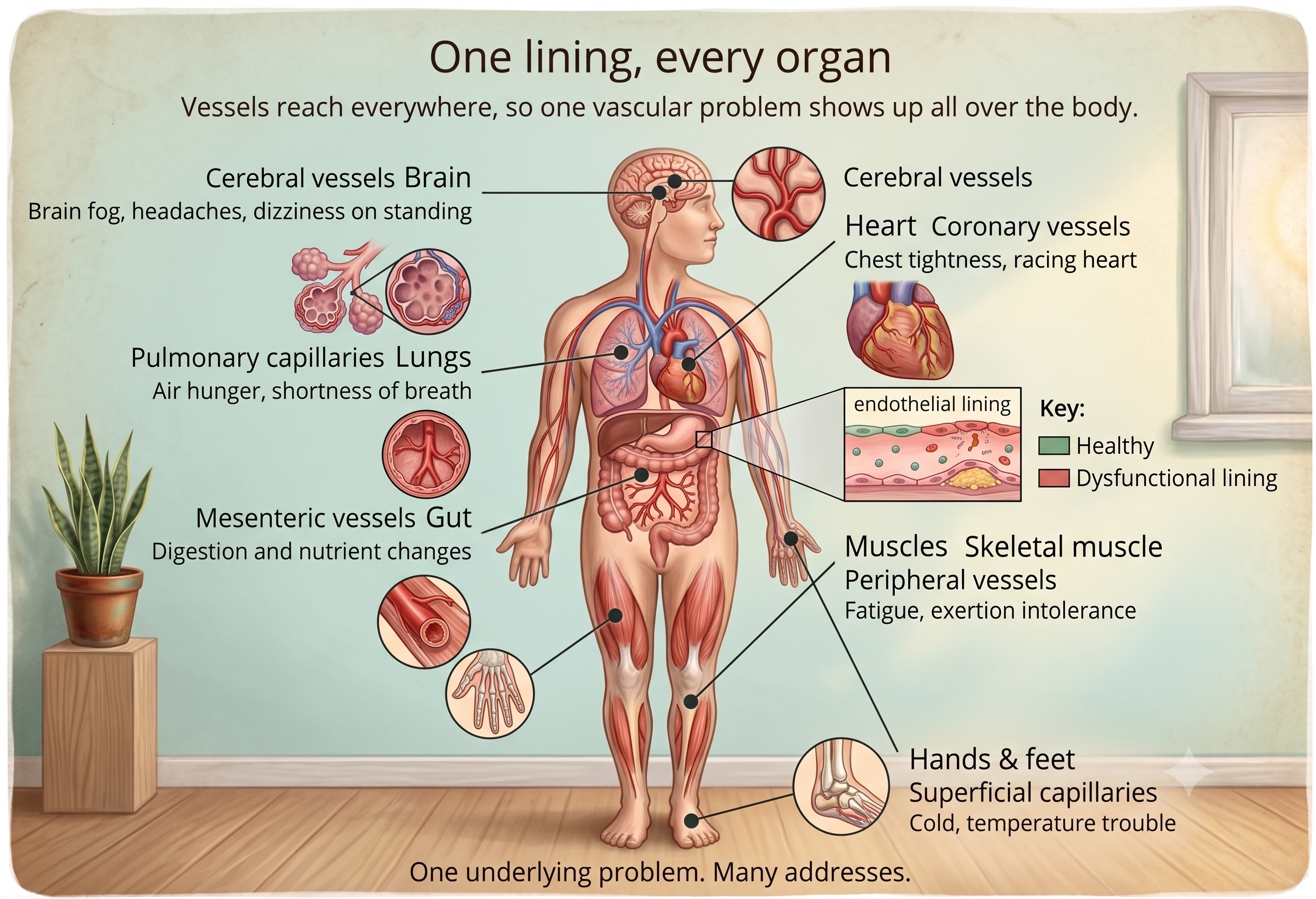
Because the endothelium lines blood vessels everywhere, a problem with it can show up anywhere: brain, lungs, heart, muscles, gut. That's why symptoms feel scattered and hard to pin to one organ. One underlying issue, many addresses. Common experiences include:
- Fatigue and a hard limit on exertion
- Shortness of breath or "air hunger"
- Chest tightness or pressure
- Dizziness or lightheadedness, especially when standing
- Headaches or migraines
- Cold hands and feet, or temperature trouble
- Brain fog and trouble thinking
The exertion trap (and why it isn't "deconditioning")
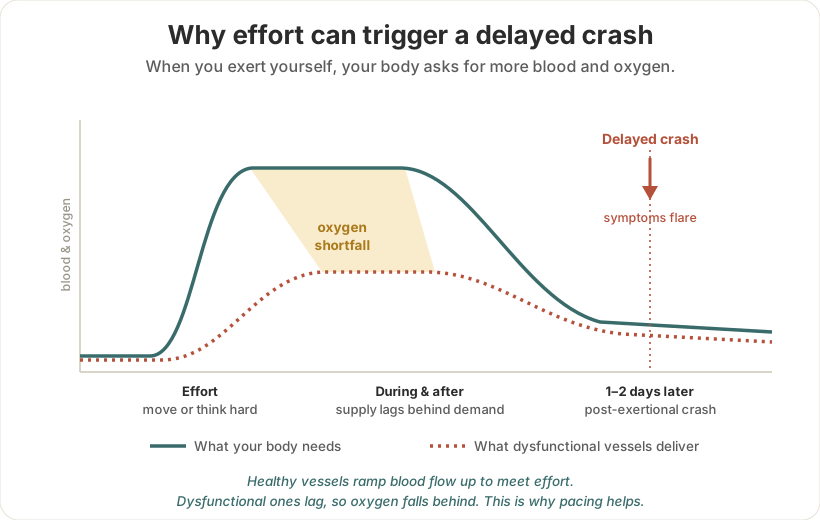
Your endothelium is supposed to ramp blood flow up when you move or concentrate hard. When it's dysfunctional, that ramp-up lags. Oxygen demand climbs but delivery falls behind, and inflammation can rise after the effort. That's a vascular reason for the crash that can follow activity, sometimes a day or two later. It's not weakness, and "pushing through" can backfire. That's the logic behind pacing: staying inside your energy envelope so you don't keep re-injuring a system that's trying to heal.

Why your tests can look "normal"
This is the frustrating, validating part: standard tests often look fine. Resting oxygen can be normal. Heart and lung scans can look reassuring. That does not rule endothelial dysfunction out, because many problems only show up under stress or exertion, and routine testing measures you at rest. "Your tests are normal" and "something real is wrong" can both be true at once.
The takeaway: the endothelium is a body-wide control system for blood flow. A virus can leave it stuck in a dysfunctional state, and that single fact helps explain why your symptoms are widespread, why effort makes them worse, and why resting tests look normal. None of it is in your head. It's in your blood vessels.
Glossary
Look up a word whenever you want. No need to read top to bottom.
Open the glossary
Endothelium — The thin, living layer of cells lining the inside of every blood vessel. A smart, body-wide coating that controls blood flow. (en-doh-THEE-lee-um)
Endothelial dysfunction — When that lining stops working properly, so vessels constrict, leak, or signal inflammation when they shouldn't.
Nitric oxide (NO) — A tiny signal the endothelium releases telling vessels to relax and widen. Less of it = vessels that don't open up when you need them to. (Not laughing gas.)
Vasodilation / vasoconstriction — Vessels widening or narrowing. A healthy endothelium balances the two.
Flow-mediated dilation (FMD) — A test of endothelial health: a cuff briefly blocks blood flow in the arm, then releases it. A healthy artery widens a lot afterward, a dysfunctional one less. Lower FMD = more impairment.
Microclots — Tiny abnormal clots, too small for routine tests, that can block the smallest vessels and starve tissue of oxygen.
Hypercoagulability — Blood that clots more easily than it should.
Capillaries — The smallest blood vessels, where oxygen crosses into your tissues.
Microvascular — Relating to the smallest vessels. Much of the long COVID damage is thought to be microvascular.
Perfusion — How well blood actually reaches and feeds a tissue.
Hypoxia — Not enough oxygen reaching tissue.
Inflammation — The immune system's alarm-and-repair response. Helpful in short bursts, harmful when it won't switch off.
Biomarker — Something measurable in blood that signals what's happening inside, like a warning light.
Endothelial senescence — When vessel-lining cells enter a worn-out "zombie" state: alive but no longer working right, leaking inflammatory signals. A leading theory for why dysfunction persists.
Spike protein — The part of the virus that enters cells. Some studies ask whether it keeps irritating blood vessels.
Orthostatic intolerance — Trouble being upright; standing brings dizziness, fog, or faintness as blood flow to the brain drops.
POTS — A form of orthostatic intolerance where the heart races on standing. Often travels with vascular and autonomic problems.
Autonomic nervous system — The automatic control of heart rate, blood pressure, temperature, digestion. When it misfires (dysautonomia), it overlaps a lot with vascular symptoms.
Post-exertional malaise (PEM) — A delayed crash after physical or mental effort, sometimes a day or two later. A hallmark of ME/CFS and much of long COVID.
Pacing — Staying within your energy limits to avoid crashes and repeated vascular stress.
ME/CFS — A long-recognized post-viral illness that overlaps heavily with long COVID, including similar vascular impairment.
Pathogenesis — The step-by-step story of how a disease develops.
Common Questions
Is this real, or is it in my head?
It's real and physical. Multiple studies here measured impaired vascular function directly. Your symptoms have a biological basis in the blood vessels.
If it's real, why are my tests normal?
Routine tests measure you at rest, and endothelial problems tend to reveal themselves under exertion or stress. Normal oxygen and reassuring scans don't rule it out. The tests that catch it (like flow-mediated dilation) are usually specialty or research tools.
Why do I feel symptoms in so many places?
Because the endothelium lines blood vessels everywhere: brain, heart, lungs, muscles, gut. One underlying problem shows up across many systems at once.
Why do I crash after doing things, sometimes a day later?
Your vessels are supposed to ramp blood flow up during effort. When the endothelium is dysfunctional, that ramp-up lags, oxygen delivery falls behind demand, and inflammation can rise afterward. That's a vascular explanation for the delayed crash, and a big reason pacing helps.
Is this just deconditioning? Should I push through and exercise?
The research frames this as a vascular problem, not simple unfitness, and "push through it" can backfire by triggering crashes. Pacing is the more common guidance. Any exercise plan should be discussed with a clinician who understands post-viral illness.
Is there a cure or a pill?
Not yet a single proven cure. Current approaches target the drivers: improving blood-flow signaling, calming inflammation, addressing microclots, supporting the autonomic system, and pacing. Improvement tends to be gradual and individual.
Can it get better?
Many people do improve over time, though the pace varies a lot from person to person. This is an area of active research.
How is long COVID connected to ME/CFS?
One study here compared the two groups directly and found similarly impaired vascular function, even though the ME/CFS patients had been ill far longer. They appear to share a vascular mechanism.
What can I actually do with this information?
Use it to understand your body and to have better conversations with your doctors. Knowing the vocabulary lets you ask sharper questions and recognize when a clinician does or doesn't understand the vascular angle.
Should I trust everything in these papers?
These are real peer-reviewed studies, but science is a work in progress. Sample sizes vary and some findings are early. Treat it as the best current understanding, not the final word, and bring decisions to a clinician who knows your case.
Reading Guide
You don't have to read these, and definitely not in one sitting. This is a map, not a homework list. Start at the top, stop whenever you've had enough. Difficulty: ● easier, ● moderate, ● dense. Each title opens the free full text (PubMed Central or publisher) in a new tab.
Level 1 — Start here (most readable, most relevant)
Level 2 — Big-picture reviews (read one to grasp the whole landscape)
Level 3 — Deeper dives (pick by what you're curious about)
Level 4 — Specialized topic (read only if it's on your mind)
↑ back to topAll Papers
Each source links to its free full text at the publisher or PubMed Central (PMC), opening in a new tab. One paper is hosted here directly under its open (CC BY) licence.
Show the full source list (19 papers)
- What is Endothelial Dysfunction
- Long COVID & ME/CFS Show Similarly Impaired Vascular Function
- Clinical Implications of COVID-19-Related Endothelial Dysfunction
- Endothelial Dysfunction in COVID-19: An Overview
- Vascular Pathogenesis in Acute and Long COVID
- Damage to Endothelial Barriers and Its Contribution to Long COVID
- Significance for Future Kidney & Heart Disease
- Virus-Induced Endothelial Senescence in ME/CFS & Long COVID
- Cerebromicrovascular Mechanisms (Brain & Cognition)
- Microvascular Remodeling (All Eyes on PCS)
- Persistent Dysfunction & Symptom Severity
- Arterial Stiffness Over 1.5 Years (Meta-Analysis)
- Endothelial & Metabolic Biomarkers in PCS
- Exploring Hypercoagulability in PCS
- Long COVID in Children & Young Adults
- Biomarker Profiles During & After Hospitalization
- Spike Protein's Sustained Effects on Vessel Cells
- COVID-19, Thrombogenicity & the SGLT2 Pathway
- Endothelial Inflammation & mRNA Vaccine Adverse Events